

If we count “the little years” as five and under, I’ve been in those years for a decade.
My oldest three children turn eleven, nine and six this fall. My youngest turns one in September. Not only have I been in the little years for a decade, I’m going to be in them for four more years. So — if I may be your Titus 2 mentor for a few minutes — I have a few thoughts on how to make Bible study a priority in the little years since I’ve been doing it (and will be doing it) for quite some time.


Before I share the practicals, I want you to know: I understand why young mothers give up on “quiet time”. I can count at least five reasons:
Time. Babies don’t observe tidy timeframes! They wake up too early, they stay up too late, they don’t nap, they eat more often than they used to. We’re constantly interrupted and this is very different than quiet-time-before-kids.
Attention. Littles are loud! They bang their Magnatiles, yell, laugh, and ask for stuff. Trying to read Jeremiah while someone says “Mom! Mom! Mom!” ten times in a row is… difficult.
Overwhelm. We don’t know where to start, or we start something and aren’t consistent — so we give up. Sometimes we circle in “easy” books like the epistles over and over because we can’t retain anything else.
Lack of a role model. If the other mothers in our community aren’t pursuing a daily time with God, it’s easy to tell ourselves what we’re going through is normal — so we don’t need to change. Some young mothers look at older mothers and their Bible study routines with envy and idealism, assuming these moms have “all the time in the world” (this isn’t true).
Priority. Everything else feels pressing. If I spend a half hour reading my Bible but the laundry gets delayed (or cancelled), my family will notice the laundry… but will they notice I was in the Word? If I spend time praying and worshiping but dinner is late, everyone will be crying for food and no one will notice I was fed by the Spirit… right?
The phrase “quiet time” is a bit problematic in itself. This phrase first appeared in the 1950s, introduced first by an Intervarsity tract and popularized by Billy Graham. Before the advent of the personal quiet time, Christians called their time with God “the morning watch”. It usually took place early in the morning and was focused on intercessory prayer — prayer for other people and their needs. From the 1950s forward, Christian spirituality became more individualistic, focused on personal devotion rather than outward intercession. While there are some great resources born from this shift, it laid the foundation for an entire industry built around aesthetic times with God (more on what Christian devotional life looked like before the printing press in this IG reel).
But if time with God requires perfect quiet, undisturbed mornings, a pile of pastel highlighters, a Logos subscription and four different Bibles, how many young mothers can show up? Not many.
If time with God requires perfect quiet, undisturbed mornings, a pile of pastel highlighters, a Logos subscription and four different Bibles, how many young mothers can show up?
Consider this post your permission slip to reinvent your quiet time. Truth be told: Your life as a mama of littles has already reinvented it for you. You can either resist this new season kicking and screaming, quit entirely, or accept it and adjust accordingly. I encourage you to choose the last option; this is the one that bears fruit.
How to Have a Quiet Time in the Little Years
Be Flexible. Rigidity is not the friend of motherhood, something all mothers learn eventually. If you’re accustomed to a ride-or-die 6 AM Bible study time, you might struggle when the baby wakes up at 5:45. Or if you think you need a full hour to rest in God’s presence, you may be alarmed at your own anger when that hour is cut short. Flexibility is your friend. Each day I have an ideal time for Scripture: morning, usually after I go for a walk and have my coffee made. But there are MANY mornings when that doesn’t happen (just yesterday, in fact!) and I find myself reading the Word in bed at 9:30 PM. God doesn’t care about when you come to meet Him. He cares that you do. You’re His child, after all. How would you look at your baby if she couldn’t be with you in the morning, but wanted to sit with you at night?
Have a Plan. Flexibility isn’t the absence of a plan; it’s willingness to bend the plan when necessary. Read that again! Some of you struggle with rigidity but some of you struggle with consistency. Recognize your weakness and work to remedy it; this gives our kids a pattern of resilience and adaptability to follow. Your Bible study plan may be as simple as “read a chapter of Proverbs each day”. It could be bigger, like “read the gospels in three months” (also achievable in a chapter a day; I did it earlier this year when my youngest was 4-6 months old). Or maybe it’s a much bigger plan, like Bible in a year (we have many young moms in my annual Bible in a Year Club course!). What matters is that — when you sit down with the Word and a journal — you know exactly where you are starting and what you’re about to do. This prevents distraction and minimizes wasted time.


Train Your Children. This sounds controversial, but it shouldn’t be. Training older children (toddlers and early elementary) to recognize and respect mom’s time in the Word is one of the gifts you can give yourself for years to come. It’s also a gift to your children. I recently talked about this in a Substack note:
My children know that mama’s time in the Word matters.
What that means: I teach my children to wait. Lovingly, with no annoyance, I tell them: “Mama is studying the Bible right now. I love your Magnatile tower. I will look at it more when I’m done.”
This flows over into other areas of motherhood: Mama is going to shower. Mama is having her coffee. Mama is talking to a friend. In sum, mama is living life fully and lovingly, and children get to be part of it! Sometimes that means waiting your turn.
This is an important life skill in many ways. But it also prevents the “mother martyrdom” common to the little years. Your “quiet time” may not be quiet and that’s important to accept. But you can still have a quiet time, and making it a priority will change your motherhood.
In the early toddler years, I train with the word “wait”. I practice this during my quiet time but I also practice it in the kitchen, when we’re in the store, when we’re reading — anywhere I can. I teach my kids to sit on my lap for a few minutes, longer each time we practice. All these skills are helpful for other settings and begin laying a foundation for their character as they age. What’s more, your children get to see you prioritizing your time in Scripture — something my parents did that I never forgot.
Don’t Fret Over Missed Days. The goal of being in Scripture and prayer is to connect with the Spirit, who transforms us by HIS power, not our own. And while Bible reading doesn’t save us, women who drift from regular immersion in Scripture begin to be dictated by self rather than Spirit. It is a slow fade, a gentle drifting, often affirmed by weak women around them. Before long, the women who are diligently seeking the Lord in the Word are seen as “extreme” or even “legalistic”. Where this drifting usually begins is in perfectionism. If we can’t get the perfect streak of reading, don’t finish every single checkbox on the plan, we give up. We stop reading entirely. We stop praying. This is not the way! Christ does not care if you miss a day. He cares about hearts that seek the kingdom. Don’t fret over a missed day. Our motto in Bible in a Year Club is “start where we are” — no matter what you’ve missed, start on the day’s reading. You can catch up later (or not).
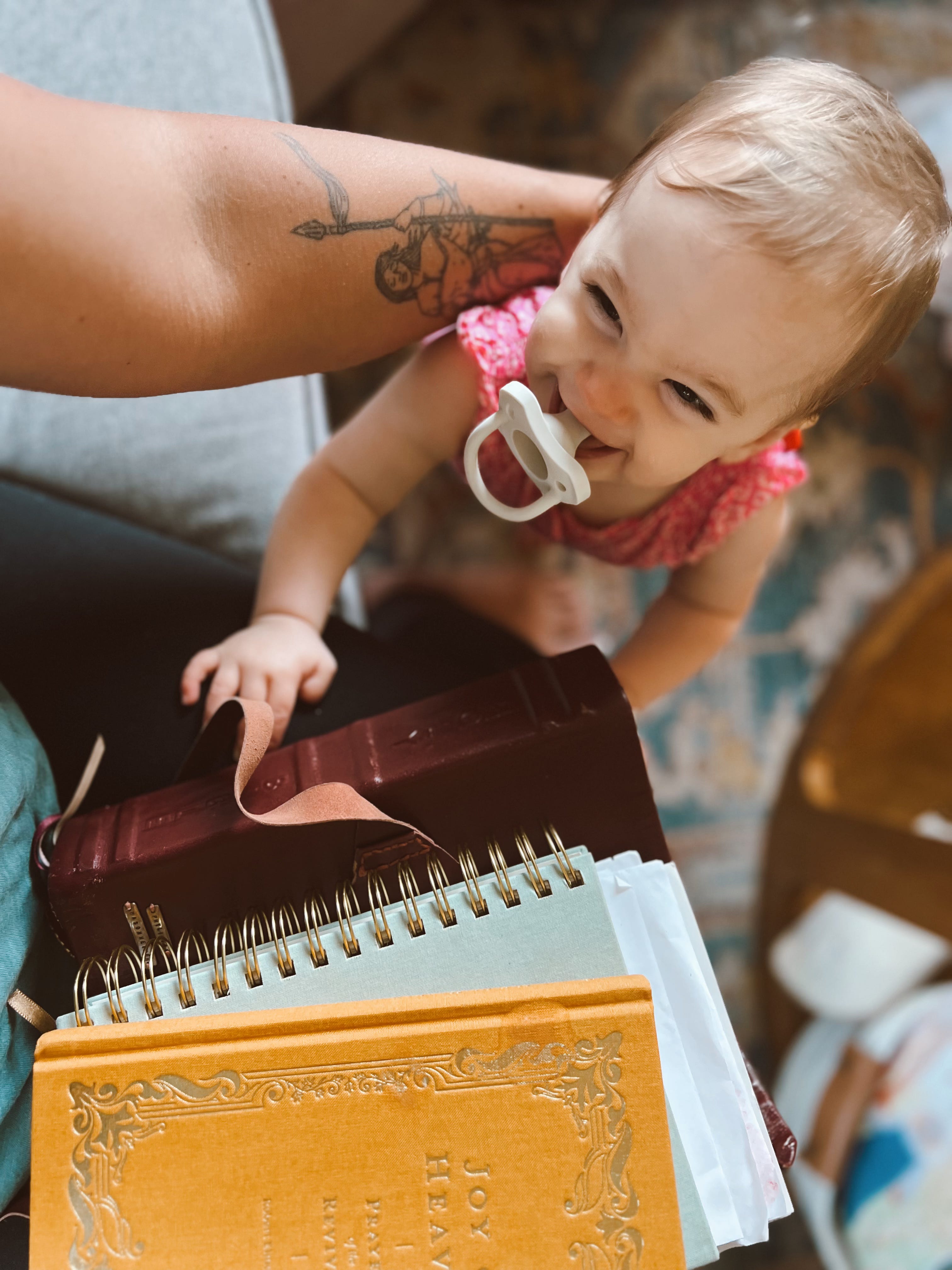
Invite Them In. Your children are curious. The little years are such a joy! They want to know what you’re reading, doing, listening to, and interested in. Capitalize on this interest by bringing them into your time with God. A few ways I did this:
Find a children’s Bible or book series and have them follow along where I am in Scripture. We used six or seven different children’s Bibles over the years.
Sit them on my lap while I pray and pray aloud over them. Tell them who and what I’m praying for. Praise God openly for His answers!
Sing hymns and Christian songs as part of your worship time. Have them sing or listen with you (the Sing! app is great for this).
Tell them what you’re learning. Even if they zone out after a minute, you can share what you’re getting out of the Word. So much of this is about putting truth in front of them by your example, even if it seems as if they aren’t listening.
Choose Your Friends Wisely. I’m now in my mid-thirties. The older I get, the better I am at discerning the kinds of women I’d have in my inner circle. When you’re a young mama (especially if you’re just transitioning out of the workforce, like I was with my oldest), you’re a bit desperate for any human interaction. Play dates, playgrounds and mom groups give you access to a wide variety of women. If you’re like I was in my twenties, you get too close, too fast.
The women in your inner circle shape you more than you know. Their influence can drive you to resent motherhood or enjoy it; to look for the best in your husband or the worst; to seek God in His Word or dismiss it as unimportant; to pray diligently or to assume prayer is pointless; to prioritize the local church or abandon it.
I’m not suggesting you leave your unbelieving friends or cease contact with people who are far from God. You may be a powerful, positive influence in their lives! But your inner circle should be chosen carefully, not from a place of pride but with an eye to spiritual formation. This is the way of wisdom. I have seen far too many young mothers drawn into a drifting, shallow “faith” by weak women with strong personalities. Be kind, and be discerning.
Don’t Give Up! Show Up. From age six to eighteen, I woke up most mornings to find my dad in the living room bent over the coffee table, his bible spread out in front of him. I could hear him praying under his breath. His handwriting was scrawled on sticky notes all over the pages, the multicolor pastels sticking out every direction. After he left for work, my mom would sit in her living room armchair and grab her Thompson Chain Reference bible from the end table. She’d read while her six children tumbled around the main floor making breakfast, pulling out school books, and toddling around her feet. She made it look easy. I now know it wasn’t.
My parents never required me to read the Bible. I don’t remember ever being assigned a “quiet time”. But when I became a Christian at fifteen, I knew exactly how to start seeking God because I watched it happen every morning.
I guess you could say that “the morning watch” isn’t just a name for our time with God. It’s a title for what our children our doing when mama shows up to meet Jesus.
The fruit of your personal devotion will take years to grow. When it does, you’ll look back on these noisy mornings with affection and longing. A decade ago I was holding my oldest in the crook of my arm as I read the Bible in our tiny Pennsylvania kitchen. Now, my oldest is learning to study on her own while her youngest sister plays at my feet. I have zero regrets about the hours I’ve spent with split attention, Magnatiles crashing, scribbles on the Psalms, and an incomplete reading plan. I’m a better mother because of it all — and you will be too.
Not a mom yet, but along the same lines- life itself will throw many things your way to either distract you or deter you from spending time with God. One teacher I listen to refers it as her "priority time" which what I like to use too to remind me of the importance being with God has in my life :)
Needed to hear this today, thank you for the encouragement!!